Snimka zaslona 2026-06-03 093328

Movetia Academy session on inclusive international mobility in Higher Education

On May 28th, more than 30 internationalisation professionals from Swiss Higher Education Institutions (HEIs) gathered online for a Movetia Academy session dedicated to Inclusion and Diversity in mobility and facilitated by Chantal Sistek and Ella Spadaro, scientific advisors at Movetia. Designed for Swiss International Relations Offices (IROs), inclusion officers and researchers, the session focused on how their institutions can widen participation and better support students with fewer opportunities. The meeting provided both strategic perspectives and practical tools to strengthen inclusive approaches in international mobility.

The session opened with a shared reflection on the barriers students with opportunities face in international mobility, ways HEIs can foster more inclusive participation and the tools and resources available for the task. Given that many Swiss HEIs are not yet actively using Erasmus+ tools and support, the first presentation, delivered by Hrvoje Ryznar, Advisor at SALTO ID ET, focused on introducing participants to the SALTO Network, explaining its role within Erasmus+ and showcasing a range of resources, services and tools designed to help HEIs implement inclusion measures. Several ways in which Swiss HEIs can benefit from capacity-building opportunities were outlined, including through mentorship offers provided by SALTO ID ET.

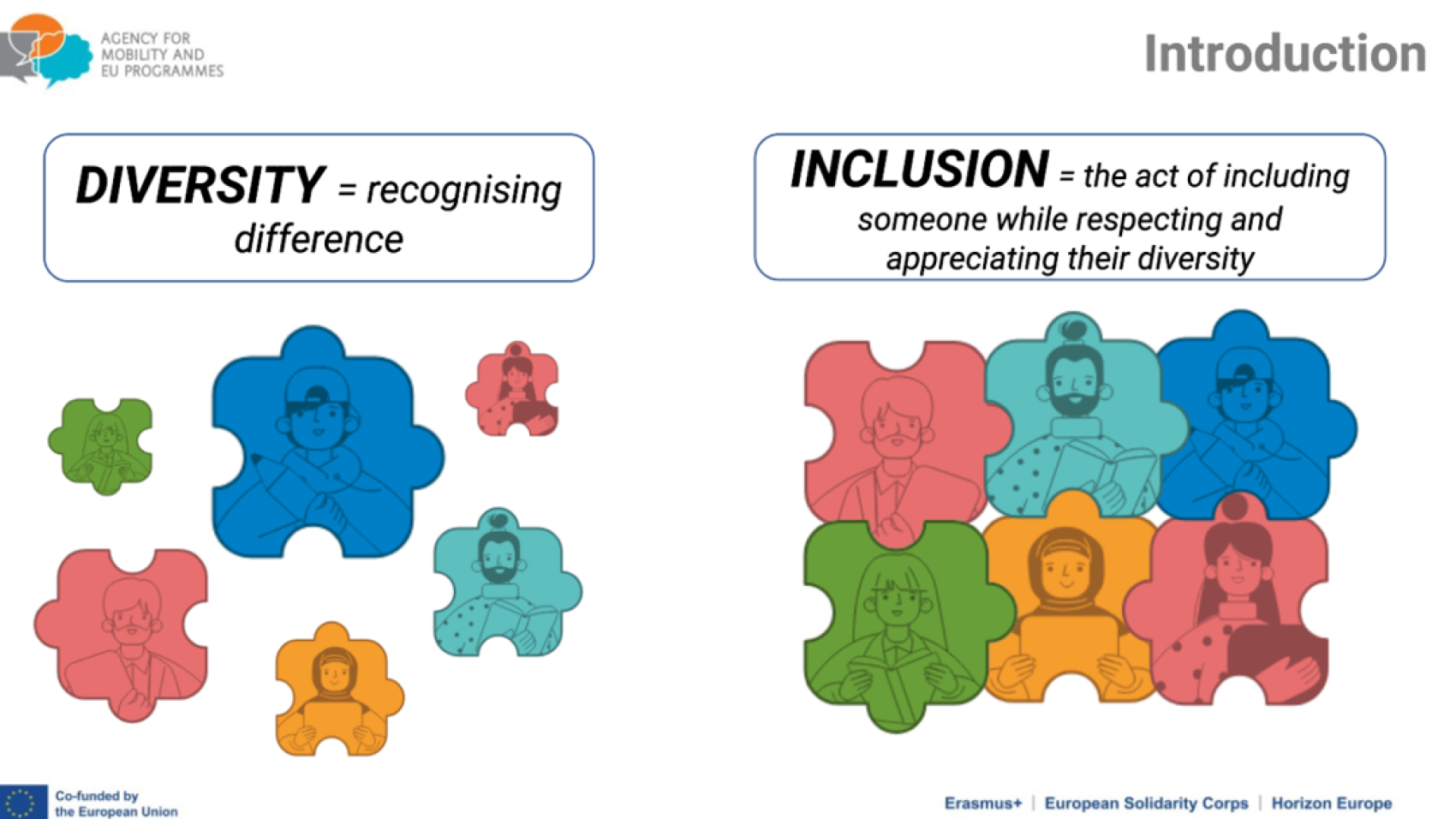
In the second keynote, Martin Bogdan (Academic Cooperation Association) introduced the DIEM project, presenting approaches to making international mobility more inclusive. He highlighted structural and individual barriers faced by students and outlined practical first steps institutions can take to develop more inclusive strategies within their own contexts.

As part of its broader mission, the Movetia Academy acts as a Professional Learning Community, where internationalisation professionals can bring their needs and experiences, share their practice, and work on their own professional challenges while collaborating and learning from one another.

 

Three people talking to each other with bubbles above them with the inscription "National Agencies Event".

SALTO inclusion session at the Erasmus+ NA Meeting in Brussels

The European Commission  organised the annual Erasmus+ National Agencies’ event from 27–29 January 2026, in Brussels. The three-day event was held at the Thon Hotel bringing together directors and staff from Erasmus+ National Agencies across Europe to discuss future of Erasmus+ programme. The agenda included both directors, horizontal and field specific sessions addressing topics such as accreditation systems, centralised actions, data analysis, and inclusion.

As part of the inclusion focus, the SALTO Inclusion and Diversity in Education and Training (SALTO ID ET) and the SALTO Inclusion and Diversity Youth (SALTO ID YOU) co-facilitated dedicated sessions. On 27 January, Dora Lukač, acting Head of SALTO ID ET, and Pieter-Jan De Graeve, team coordinator of the SALTO ID YOU, led a session for approximately 100 National Agency directors, and on 28 January, they co-facilitated a similar session for around 60 NA staff members.

During these sessions, participants examined both existing measures and tools that could be improved, alongside new ideas aimed at increasing opportunities for persons with fewer opportunities. The discussions contributed to shaping potential updates to current measures and the development of new ID initiatives in Erasmus+ post-2027. Key topics addressed included the Erasmus+ ID Strategy, accessibility and user-friendliness of the programme, specific programme actions such as accreditations and small-scale partnerships, financial support mechanisms, funding rules and unit costs, as well as NA-level outreach and support, and open topics for new proposals.

Each session followed a clear structure, beginning with a 5-minute framing and introduction, followed by a 25-minute reality check on how inclusive current practices are and what improvements can be made. Then, participants engaged in a 40-minute forward-looking discussion to envision the future of inclusion within Erasmus+. The session concluded with a 20-minute overview summarising key points, and the proposals and insights shared by participants will be carefully analysed and considered in the ongoing preparation and development of future programme measures.

A logo of the SALTO network spelling "SALTO News", with a small airplane flying off from a yellow sun-like circle.

The September edition of SALTO News is out!

The EU’s next long-term budget (MFF) will define how much funding will be available for a range of important causes, such as cross-border education, training and solidarity. Until October 8th, the European Commission gives you the chance to give your feedback in a public consultation exercise on the next MFF. 

In this month’s edition of SALTO News, you will also find: 

  • Other calls and publications. 

SALTO News is the official newsletter for the SALTO community—a network of 11 resource centres dedicated to promoting and enhancing the Erasmus+ and European Solidarity Corps programmes. You can browse previous editions of the newsletter here! 

To stay informed about the most recent developments and never miss an update, be sure to subscribe to SALTO News today!