Inclusion-Oriented Education for Sustainable Development
Katarina Rončević, PhD
Greenpeace
Every year, thousands of schools, universities, and adult education providers apply for funding through the Erasmus+ programme, driven by a shared passion to innovate and transform education and training across Europe. At the absolute core of the current Erasmus+ programme generation lie four overarching thematic priorities designed to inspire and shape the future of European society, two of which are “inclusion and diversity” and the “environment and the fight against climate change.” Today, national agencies, project managers, and evaluators have a unique opportunity to build a bridge between these two areas, moving beyond separate evaluation categories to unlock incredibly creative, holistic synergies in green inclusion.
However, in the education context, a growing body of academic research reveals that these two priorities – Inclusion and Sustainability – are deeply, structurally interconnected. A truly sustainable future cannot be achieved if segments of the population are left out of the conversation. If our ecological transition isn’t inclusive, it risks leaving the most vulnerable behind, meaning that the foundational goals of sustainability – equity and social justice – remain entirely out of reach. For Erasmus+ national agencies that process applications and steer project impact, understanding this intersection, which can be understood as inclusion-oriented education for sustainable development (ESD), is the key to unlocking the full potential of European education and training.
The Core Concept: What is Inclusion-Oriented ESD?
To understand why these priorities overlap, we must look at how they function in everyday learning environments. ESD empowers individuals to analyse, reflect, and act responsibly in the face of ecological, societal and economic crises. On the other side, Inclusive Education (IE) ensures that all learners – regardless of, e.g. disabilities, socioeconomic background, cultural differences, gender, or geographical barriers – can participate actively in education from the very beginning, dismantling systemic barriers that cause marginalisation.
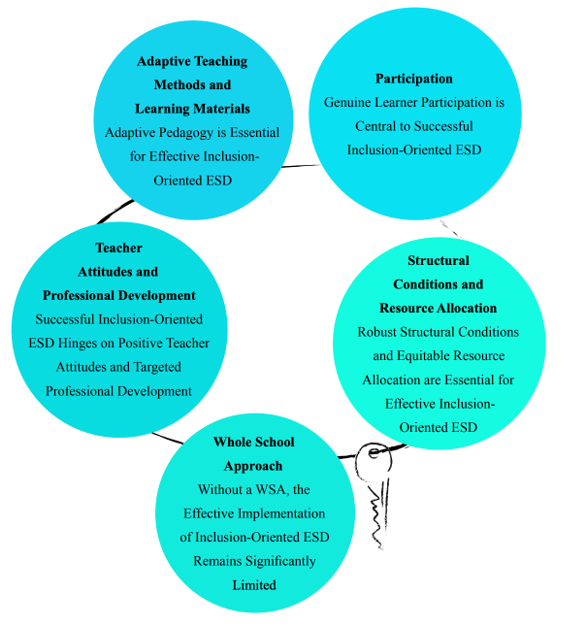
On an operational level, bringing inclusion-oriented sustainability into education and training relies on essential pillars:
- Adaptive Pedagogy and Materials
Standardised, “one-size-fits-all” teaching formats fail to reach modern, diverse classrooms. Educators must design learning environments where content, media, and pacing are tailored to individual needs without lowering the shared learning goals. When projects tackle complex sustainability topics like climate change, biodiversity, or fair trade, they need open, inquiry-based, and project-oriented learning formats.
Accessibility is the defining factor here. Students with special educational needs require adapted learning materials, such as tactile graphics, physical models, or texts translated into Easy Language. Furthermore, integrating digital assistive technologies – like screen readers, speech-to-text software, and customisable digital learning platforms – creates a digitally inclusive approach to sustainability education, known in contemporary research as “BNE diklusiv“. Erasmus+ partnerships provide the perfect funding framework to develop and test these innovative, accessible materials across European borders.
- Mindsets and Professional Capacity
The success of any inclusive, sustainable project stands and falls with the mindset of the educators involved. A teacher’s professional values, beliefs, and attitudes fundamentally shape the classroom climate and determine how students engage with complex global challenges. While a positive, appreciative approach to diversity ensures every child feels valued, empirical studies indicate that many educators feel underprepared to teach inclusion and sustainability simultaneously. This highlights a critical area for Erasmus+ Key Action 1 (Staff Mobility) and Key Action 2 (Partnerships for Cooperation): funding targeted, practical professional development that equips educational staff with the concrete competencies, tools, and confidence to manage diverse, green classrooms effectively.
- Genuine Learner Participation
True participation is the heartbeat of Green Inclusion. It ensures that all learners, regardless of their starting point or ability, actively contribute to collective decisions and eco-actions, moving far beyond tokenistic “pseudo-participation.” When young people plan and implement their own environmental projects locally – such as school gardens, recycling systems, or energy-saving campaigns – they experience genuine self-efficacy. This hands-on responsibility builds democratic competencies, fosters active citizenship, and ensures that marginalised groups are actively leading the green transition rather than just observing it.
- Structural Conditions and Resource Allocation
Stable structural conditions and equitable resource allocation underpin the successful integration of inclusion-oriented ESD. These core structures and support mechanisms cultivate educator leadership, granting them the critical agency and resources to champion educational transformation.
- The Systemic View: The Whole Institution Approach
For inclusion to be sustainable over the long term, it cannot remain a series of isolated projects driven solely by a few passionate educators. It must permeate the entire educational ecosystem through what is known as the “Whole Institution Approach.” This holistic framework demands the collaborative engagement of all stakeholders within an institution – including school leadership, teachers, students, parents, facility staff, and the local community.
Projects adopting this approach look at the big picture: how sustainability and inclusion are woven into institutional governance, daily campus operations, and the school’s cultural fabric. When embedded structurally, these principles remain viable and resilient over the long term, independent of individual staff turnover or the end of a specific funding cycle.
From Theory to Practice: Schools for Earth
A prime example of the Whole School Approach in action is the Schools for Earth initiative, a flagship project by Greenpeace Germany. This project systematically guides entire school communities to reduce their ecological footprint while embedding climate protection, sustainability and democracy into their daily governance, curriculum, and institutional culture. It shows how environmental education can transform a whole institution from the ground up. To see how this connects seamlessly with inclusive didactics, one can look at the School am Hirtenweg in Hamburg, a school for learners with special needs. This school has long been collaborating with the Schools for Earth Project and, as part of its commitment, made the first solar-powered charging station at a school in Germany possible, allowing students to charge their electric wheelchairs or speech assistants sustainably. This was the result and success of a group of female students who campaigned for it. In this example, sustainability was not just taught as a theoretical subject, but was rather lived daily through unconditional acceptance and maximum pedagogical flexibility.
The suggested references are available in the PDF version of the article.