

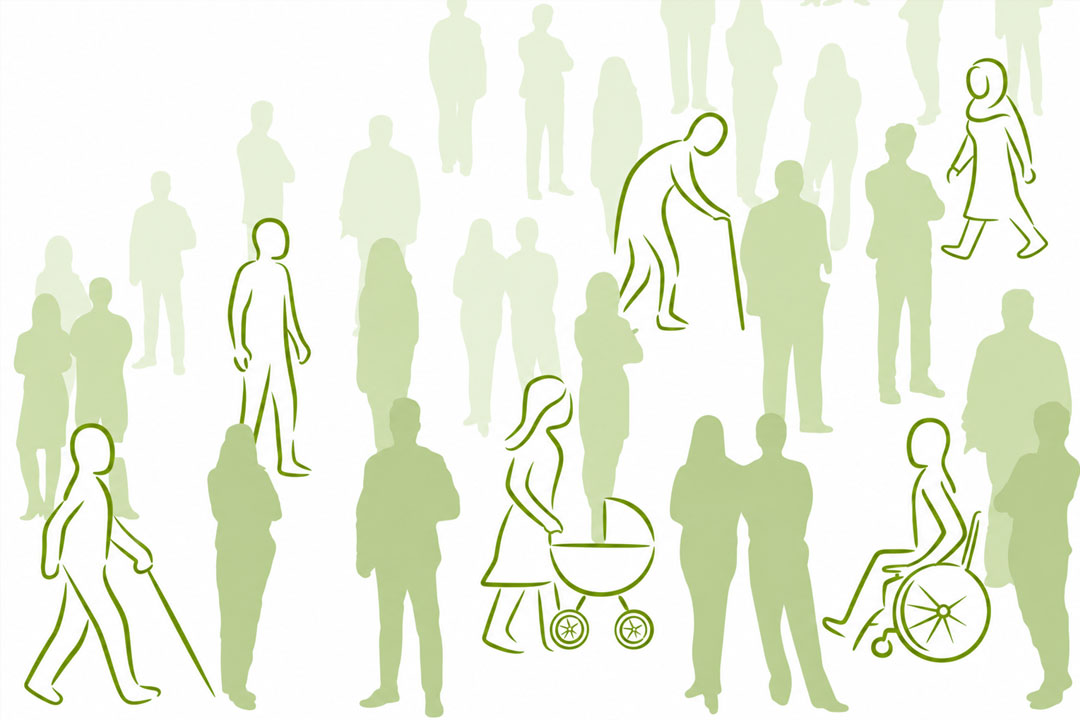
Designing Cities for Everyone: Learning from Barriers, Planning for Inclusion
| Organisation | University of Ljubljana, Faculty of Architecture |
| Country | Slovenia |
| Project title | Sustainable Accessible Future Environments (SAFE) |
| Project number | 2022-1-SI01-KA220-HED-000085619 |
| Format | Cooperation partnerships in higher education |
| Sector | Higher education |
| Target group | Higher education students and staff, municipalities, urban planning professionals, community organisations, NGOs, SMEs and people with fewer opportunities |
| Erasmus+ project results | https://erasmus-plus.ec.europa.eu/projects/search/details/2022-1-SI01-KA220-HED-000085619 |
Experiencing the same city differently
Imagine standing at the bottom of beautiful cobblestone stairs in a Mediterranean city on a hot summer day. It seems exciting to discover what lies beyond them. Can you see yourself taking a leisurely stroll along a riverbank in the afternoon or enjoying the view from a marina at sundown? Relaxing, isn’t it?
These experiences may seem simple, pleasant and mundane. But are they equally accessible to everyone? A public square can feel open and welcoming to one person, yet difficult or unsafe to another. A route that seems straightforward on a plan may contain steep steps, poor lighting, unclear signs or places where someone feels exposed. These details can affect whether a person can move independently, participate in community life and feel that the city belongs to them too.
To connect urban design and social inclusion, the Sustainable Accessible Future Environments project (SAFE) brought together universities, municipalities, community organisations and citizens in five cities: Granada, Bydgoszcz, Vantaa, Kiel and Kranj. This cooperation partnership explored how future professionals could learn to create public spaces and services that are sustainable, accessible, inclusive and safe for everyone.
Five cities became classrooms
Accessibility requires more than removing physical barriers. Architecture, urban planning, public services, safety and social participation all shape how people experience a place.
SAFE addressed these with blended learning modules and five Intensive Study Programmes (ISPs). Each programme began with online preparation, followed by five days of international group work, field research and engagement with local stakeholders. Afterwards, students reflected on their experiences at their home institutions. Students used behavioural mapping, environmental analysis, interviews and scenarios to understand how people navigated urban spaces, where they encountered difficulties and what influenced accessibility, comfort and safety.
Altogether, SAFE involved more than 120 students and reported more than 500 ECTS credits linked to the activities. Community research across the five cities included 345 interviews, while workshops and multiplier events involved more than 200 participants. This Erasmus+ mobility format had a strong digital component. It allowed students and staff from different countries and disciplines to co-develop accessible urban planning approaches and consider how they could transfer those methods to their institutions.
Imagining the cities
Residents and community organisations joined universities and municipalities in interviews, fieldwork and workshops. The activities explored the experiences of older people, people with physical, visual or sensory disabilities, people with autism, people with limited digital skills, women with migrant backgrounds, families and residents affected by poverty, discrimination or social exclusion.
The studies considered whether people could reach an entrance without assistance, understand a route under stress or find somewhere to rest. They also examined whether women, people with disabilities and people from different social or cultural backgrounds felt equally able to use these spaces.
Their feedback showed that safety and inclusion have both physical and emotional dimensions. Access means not only entering a place, but also feeling confident, respected and welcome. Students observed how professional decisions shape everyday life.
“Many of us have guide dogs, but certain transport options don’t allow them, which limits our mobility even further.”
Luka from Kranj, Slovenia
Through scenario workshops and multiplier events, participants tested accessibility tools in urban settings and developed local scenarios, guidelines and policy recommendations. Partners also compared methods, recurring barriers and possible responses across different urban contexts.
Each city brought a different dimension of exclusion into focus. Kranj explored housing design for diverse mobility, visual and sensory needs. Granada addressed the effects of steep terrain, historic streets, heavy tourism and sensory overload. Kiel examined how physical barriers interact with poverty, migration, discrimination and safety, particularly for women with migrant backgrounds and people with disabilities. Ageing was addressed in two different settings. Vantaa investigated barriers faced by older airport passengers, while Bydgoszcz considered how inaccessible infrastructure and digital public services can deepen exclusion.
Creating possible futures is a shared responsibility
The project produced open educational and practical resources, including a handbook, case studies, accounts of overlooked experiences, a digital accessibility toolkit and an international learning module.
Available through the SAFE Learning Community, these resources support interdisciplinary teaching and provide methods that universities, municipalities and practitioners can adapt. By involving municipal representatives, SAFE also connected education with local policy and produced guidelines and recommendations for strategic planning.
The international partnership created a shared way of understanding how people experience the same city differently. It brought together perspectives from architecture and urban planning, safety and tourism, social work, gender studies, socioeconomic and digital inclusion, as well as insights from people on the autism spectrum.
“It’s getting harder to move around. Overpasses and underpasses are being replaced with crosswalks, which makes it more difficult. The green light at crosswalks is too short for people with mobility issues.”
Aada from Vantaa, Finland
Both students and staff were highly satisfied with the training programmes. Students reported that they had improved their understanding of accessibility and safety challenges in EU cities and had gained valuable skills for their studies, careers and personal lives.
SAFE established a practical approach for continued action. For the future architects, planners and other professionals who took part, the project demonstrated a shift from designing for people towards learning with them and designing with them, recognising lived experience as an essential form of knowledge alongside professional and disciplinary expertise.
The accessibility, safety, and sustainability of a city cannot be separated from the needs and experiences of the people and communities who live in it. Considering these issues does not lead to immediate transformation. It does, however, make exclusion harder to overlook.